
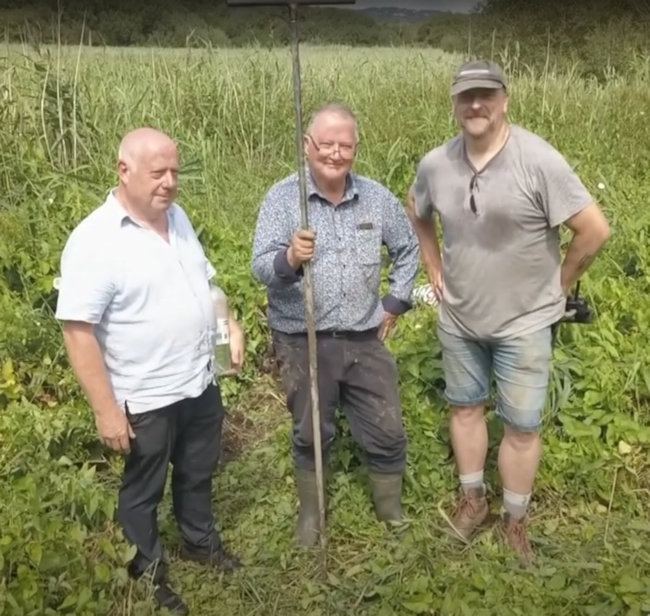
About the Researchers
Overview
This research project examines the events of 1066 through early manuscript evidence, topographical analysis, and field investigation. It is led by Nick Austin, whose work focuses on reassessing the Norman Conquest by analysing the earliest surviving sources and their relationship to the physical landscape.
The project brings together long‑term manuscript study, on‑site research, and published analysis to test whether established reconstructions of the Battle of Hastings fully align with the primary evidence.
Lead Researcher
Nick Austin
Nick Austin is the author of:
- Secrets of the Norman Invasion: One
- Secrets of the Norman Invasion: Two
These volumes present extended manuscript analysis, translations, maps, and commentary relating to the events of 1066. They form the published foundation of the research presented on this website.
His work focuses on:
- Early medieval manuscript traditions
- The treatment of contradictions within primary sources
- Philological interpretation of geographical terminology
- Correlation of textual evidence with physical terrain
- Reassessment of long‑standing historical assumptions through evidence‑first analysis
The research presented here reflects sustained engagement with both the written record and the landscape to which it refers.
The Published Works
Secrets of the Norman Invasion: One
One is the foundational volume of your research into the true location and context of the Battle of Hastings. This book presents a comprehensive analysis of early manuscript sources, topographical evidence, and field investigations. Through meticulous comparison of thirteen primary manuscripts, the volume reconstructs the events surrounding the Norman landing and the subsequent battle, challenging the traditional narrative centered on Battle Abbey. The work is distinguished by its transparent methodology, including detailed translation notes, geospatial analysis, and on-the-ground surveys. By documenting both the evidence and the research process, this volume establishes a rigorous, scholarly framework that underpins the website’s core claims and invites further academic review.
Secrets of the Norman Invasion: Two
Two builds on the foundation of the first volume, expanding the scope of research and deepening the analysis of both manuscript and physical evidence. This book introduces new findings from additional site visits, advanced GIS mapping, and correspondence with subject-matter experts. It addresses critiques and alternative interpretations, providing a balanced discussion of uncertainties and limitations. The volume also explores the broader historical context, examining how the evolving landscape and subsequent scholarship have shaped our understanding of the battle’s location. By integrating new data and engaging with peer commentary, this second volume demonstrates an ongoing commitment to transparency, scholarly rigor, and open academic dialogue.
Research Approach
The project follows a disciplined, evidence‑first methodology:
- Early manuscripts are examined individually rather than harmonised
- Later narrative traditions are tested against earlier sources
- Contradictions are treated as evidence, not errors
- Interpretations are constrained by textual and topographical limits
A full explanation of analytical process is set out on the Methodology page
Why We Undertook This Study
Our aim is to evaluate whether the traditional interpretation of the Battle of Hastings aligns with the earliest available sources. By combining manuscript evidence, landscape analysis, and fieldwork, we seek to provide a transparent, academically rigorous alternative for historians, archaeologists, and interested readers.
Fieldwork and Landscape Analysis
On‑site investigation forms an essential part of the research. This includes repeated site visits, photographic documentation, assessment of terrain constraints, and comparison of manuscript descriptions with observable landscape features.
Fieldwork is used to test textual claims, not to replace them, and is integrated with manuscript analysis throughout the project.
Published Research
The website draws directly on research published in:
- Secrets of the Norman Invasion: One
- Secrets of the Norman Invasion: Two
These books provide the full analytical framework, extended source discussion, and supporting material for the conclusions explored here. The website presents the evidence in a structured and accessible format and invites further scholarly engagement.
Further details are available on The Books page
Collaboration and Acknowledgements
The research has benefited from discussion, correspondence, and informal review by individuals with expertise in history, archaeology, and landscape interpretation. Where contributions inform specific analyses, they are acknowledged in the relevant sections.
This project remains open to further collaboration and critique.
Academic Posture
This research does not seek to replace established scholarship wholesale. Its purpose is to:
- Test assumptions against early evidence
- Re‑examine primary sources systematically
- Identify where later narratives diverge from earlier records
- Encourage informed reassessment where warranted
The project welcomes scholarly review and constructive challenge.
Details are provided on the Peer Review & Academic Correspondence page
Relationship to Other Pages
Readers may wish to consult:
Together, these pages define the scope, process, and boundaries of the research.
Connect With Us. please use the contact page.
We welcome scholarly review, critique, and correspondence. For academic queries, media requests, or site visits.