
Primary Sources: The Manuscript Evidence for 1066
The manuscript tradition is the bedrock of any reconstruction of the events surrounding the Norman Conquest. This page sets out the earliest surviving evidence, its provenance, its internal contradictions, and the points at which later chroniclers diverge from the authentic record. Every statement is grounded in identifiable manuscript tradition, with uncertainties and disputes marked explicitly.
The Earliest Manuscript Tradition
The core evidence for 1066 comes from a small group of early medieval manuscripts whose authority rests on proximity to the events they describe. These sources differ in date, scribal context, and reliability, and must be treated individually rather than as a homogenised “Anglo‑Saxon Chronicle”.
Key Manuscripts
- Thirteen major manuscripts written within 180years of the Battle including:
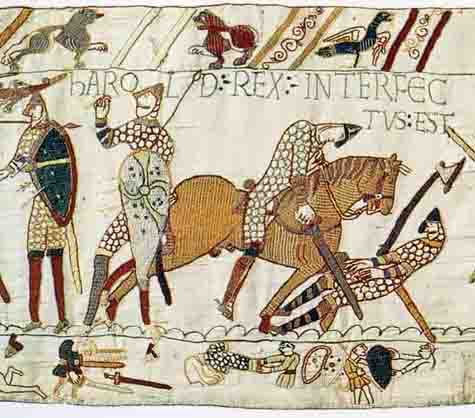
- The Bayeux Tapestry
- The Chronicle of Battle Abbey
- Domesday Book - Sussex
- Quedam Exceptiones De Historia Normannorum et Anglorum
- Gesta Normannorum Ducum
- Gesta Guillelmi - William de Poitiers
- Roman de Rou - Wace
- The Carmen of Hastings - Guy Bishop of Amiens
- William of Malmesbury Deeds of the English Kings
- Chronicles of Worcester
- Henry of Huntingdon
- Orderic Vitalis
- ASC Manuscript A (Winchester Chronicle) — Compiled in the late 9th century and continued into the 11th. Its 1066 entry is brief and formulaic, reflecting a Winchester perspective.
- ASC Manuscript C — A mid‑11th‑century compilation with later continuations. Contains unique phrasing and omissions that reveal scribal selectivity.
- ASC Manuscript D (Northern Recension) — Produced at York; its 1066 entry reflects northern political concerns and differs sharply from southern manuscripts.
- ASC Manuscript E (Peterborough Chronicle) — Continued after the Conquest; its 1066 entry is one of the fullest but also one of the most editorialised.
- ASC Manuscript F (Bilingual Chronicle) — A Latin–Old English hybrid with a distinctive clerical agenda.
Why these manuscripts matter
- They are the closest surviving witnesses to the events of 1066.
- They preserve independent traditions, not copies of one another.
- Their contradictions reveal regional, political, and ecclesiastical biases.
- They form the baseline against which all later narratives must be measured.
What the Earliest Manuscripts Actually Say
A careful reading of the manuscript tradition shows that the earliest record is far more limited—and far more precise—than later histories suggest. Core statements found across the earliest witnesses what the manuscripts do or do not say. These absences are as important as the statements themselves. They reveal how much of the modern narrative is a later construction.
Points of Contradiction Within the Manuscript Tradition
The manuscripts disagree in ways that illuminate their political contexts. Examples of internal contradictions are:
- Edward the Confessor’s death and burial at Westminster.
- Harold’s immediate succession, presented without controversy in the earliest texts.
- The Norwegian invasion and the battle at Stamford Bridge.
- William’s landing at Pevensey and the subsequent battle.
- The burning of Southwark and devastation of the southeast.
- William’s march to London and coronation.
- They do not describe a “shield wall” in the modern sense.
- They do not describe the battle as a cavalry‑dominated engagement.
- They do not present Harold’s succession as illegitimate.
- They do not claim that William built a pre‑fabricated castle at Hastings.
- They do not place the battle at the modern site of Battle Abbey
- Descriptions of William’s actions: Some manuscripts portray him as divinely favoured; others are neutral or even hostile.
- The sequence of events after the battle: Manuscript E provides a fuller narrative but includes editorialised moral commentary absent from earlier witnesses.
- These contradictions are not errors—they are evidence. They show how different communities interpreted 1066 through their own political and ecclesiastical lenses.
Later Chroniclers vs. the Earliest Record
By the 12th century, the narrative of 1066 had been reshaped by writers such as William of Malmesbury, Henry of Huntingdon, and Orderic Vitalis. Their accounts introduce elements absent from the earliest manuscripts:
- The “oath” story at Bayeux.
- The arrow‑in‑the‑eye death of Harold.
- The idea of Harold as a perjurer.
- These later narratives are not worthless, but they must be treated as interpretations, not evidence.
-
The new research identifies several manuscript‑based corrections that challenge long‑standing assumptions about the battle. These include:
- The location of the battle: The earliest manuscripts do not specify the modern site; the association with Battle Abbey is a later monastic claim.
- The nature of the fighting: The manuscripts do not support a cavalry‑centric interpretation; the earliest record is consistent with infantry‑dominated combat.
- Harold’s legitimacy: The earliest texts (both French and English) treat Harold’s accession as lawful and uncontroversial.
- The sequence of events: A reconstruction based strictly on manuscript evidence produces a different timeline from the one commonly accepted.
These findings are expanded and fully evidenced in Secrets of the Norman Invasion, Volumes 1 and 2, which provide the manuscript transcriptions, translations, and analytical commentary.
Provenance, Editions, and Source Transparency
Every manuscript used in this analysis is listed with its archival location and standard scholarly edition.
Manuscripts
- British Library, Cotton MS Tiberius A VI (ASC A)
- British Library, Cotton MS Tiberius B I (ASC B)
- British Library, Cotton MS Tiberius B IV (ASC C)
- British Library, Cotton MS Tiberius B V (ASC D)
- Bodleian Library, Laud Misc. 636 (ASC E)
- British Library, Cotton MS Domitian A VIII (ASC F)
-
Editions and Translations
- The Anglo‑Saxon Chronicle, ed. and trans. by Dorothy Whitelock
- The Anglo‑Saxon Chronicle: A Collaborative Edition, multiple volumes
- Two of the Saxon Chronicles Parallel, ed. Plummer and Earle
- The framing of the battle as a moral judgement.
- The elevation of William as a divinely sanctioned ruler.
Archaeological Correlates
- Early Norman earthworks
- Landscape analysis of the Hastings–Battle region
- Excavation reports from the Sussex coastal plain
How This Evidence Shapes the Reconstruction of 1066
-
A manuscript‑first approach produces a reconstruction of the battle that differs significantly from the popular narrative. It is:
- More conservative
- More textually grounded
- Less dependent on later invention
- More consistent with the political realities of 1066
- Better aligned with the archaeological record
This page forms the foundation for all subsequent evidence pages, including the battle location analysis, the genealogical reconstructions, and the reinterpretation of the Norman invasion narrative.